Architectural Comparison: Traditional Automation vs. AI Agents
| Feature / Capability |
Legacy Staffing Automation |
Generative AI Chatbots |
Autonomous AI Agents (Agentic) |
| Trigger Mechanism |
Static "If-This-Then-That" rules |
User-prompted conversational queries |
Operational event triggers & continuous observation |
| Adaptability |
Breaks on non-standard data |
Generates plausible language only |
Evaluates context and determines multi-step execution paths |
| System Scope |
Isolated to single point solutions |
Sits as an overlay or browser tab |
Deep, bi-directional integration across front, middle, and back office |
| Operational Impact |
Sends scheduled reminders |
Speeds up email drafting |
Executes shift fulfillment, intake screening, and collections |
| Human Role |
Constant manual intervention |
Prompter and copy-editor |
Strategic manager overseeing edge cases and exceptions |
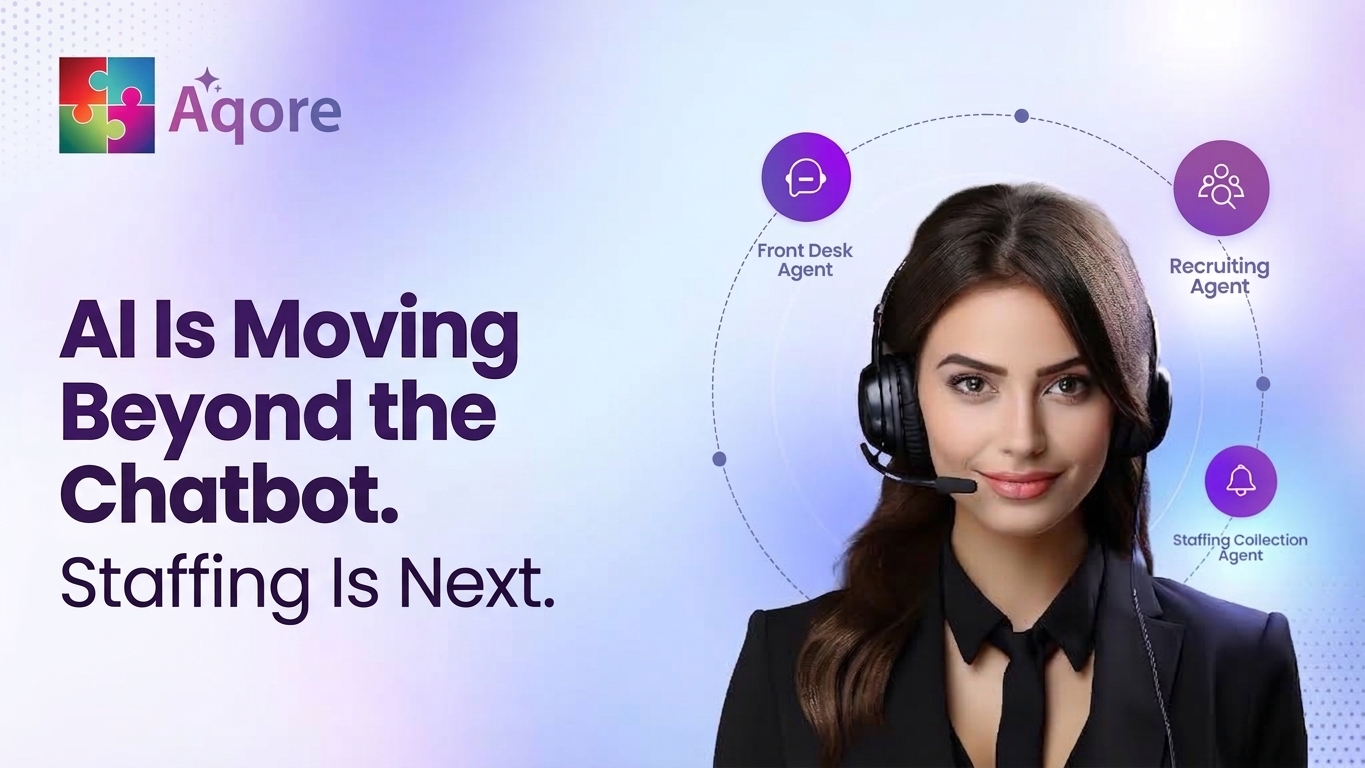
The 3 Autonomous Agents Reshaping Front-to-Back Staffing
Real operational leverage does not come from standalone software point solutions. It comes from autonomous agents working inside your core staffing software to eliminate operational friction.
Here is how modern staffing firms deploy autonomous agents across their day-to-day operations:
End-to-End Autonomous Staffing Agent Workflow
Front Office
AI Recruiter Agent
(24/7 SMS Intake)
Middle Office
AI Staffing Specialist
(Roster Dispatch & Match)
Back Office
AI AR Collector Agent
(DSO & Timecard Audit)
CENTRAL RELATIONAL DATABASE CORE
Zero API Sync Delays • Zero Lost Data
1. The 24/7 AI Recruiter Agent (Crushing Candidate Ghosting)
In high-volume staffing, candidate acquisition dollars are wasted if candidates drop out before pre-screening.
When an applicant applies at 11:00 PM on a Friday:
- The AI Recruiter Agent initiates conversational engagement within 90 seconds via SMS or WhatsApp.
- It verifies minimum qualifications, driver’s license or transit reliability, shift availability, and hourly pay expectations.
- It collects missing profile details, validates work authorization parameters, and updates the core ATS record in real time.
- If qualified, it automatically schedules the candidate for branch orientation or a video interview, notifying the recruiter's calendar.
By removing human availability bottlenecks from initial intake, agencies reduce candidate drop-off, increase applicant-to-interview conversion, and secure talent before competing firms review the resume.
2. The AI Staffing Specialist Agent (Autonomous Roster Dispatch)
Managing sudden call-outs or filling a 40-person light industrial shift traditionally requires recruiters to work down a spreadsheet, dialing candidates one by one.
The AI Staffing Specialist Agent handles the fulfillment cycle systematically:
- It analyzes open shift requirements against internal database talent, ranking candidates based on proximity, credentials, past shift attendance records, and pay/bill rate spreads.
- It orchestrates instant multi-channel outreach, dispatching shift offers to the top-matched talent tier.
- As candidates confirm via text, the agent locks their placement onto the client roster, triggers orientation instructions, and updates branch dispatch boards.
- If a worker declines or fails to respond within a set timeframe, the agent moves down the priority matching matrix to fill the vacancy.
Agencies using this autonomous matching framework achieve an 89% placement accuracy rate on recommended talent, condensing four hours of manual dispatching into minutes.
3. The AI AR Collector Agent (Compressing DSO by up to 40%)
Growth in high-volume staffing is cash-intensive. Waiting 60 to 90 days for client invoice settlement restricts credit lines and constrains payroll expansion.
The AI AR Collector Agent connects back-office invoicing directly with operational timesheet records:
- It monitors aging receivables daily, categorizing client accounts by payment habits and credit risk terms.
- It automatically issues customized, professional payment reminders to client accounting contacts, attaching verified timesheets and purchase orders.
- When discrepancies arise (e.g., disputed supervisor signatures or unapproved overtime), the agent aggregates the audit trail from the middle-office timecard engine and routes it to the designated account manager for resolution.
By automating systematic, audit-backed invoicing follow-ups, staffing firms report reducing Days Sales Outstanding (DSO) by up to 40%, protecting liquidity without damaging client relationships.
The Architectural Rule: Why AI Agents Fail Without Unified Data
There is a fundamental software requirement that determines whether an AI agent succeeds or fails: agents cannot operate across disconnected software tools.
If an agency uses one ATS, a separate middle-office onboarding software, a third-party time clock system, and an external payroll/billing tool, an AI agent will stall. Every custom API bridge introduces latency, permission mismatches, and data synchronization failures. An agent cannot safely dispatch a shift if it cannot instantly confirm whether a worker's I-9 verification or background check cleared in a separate software silo.
As explored in our technical deep-dive on Unified Staffing Technology by Aqore, true agentic efficiency requires a single relational database:
- One Continuous Record: A candidate record transforms into an active assignment, a timecard, an invoice line-item, and a payroll record without human data re-entry.
- Instant Margin Protection: Front-office agents calculate state-specific burden, worker’s comp codes, and statutory requirements before an offer is dispatched.
- Complete Context Awareness: The AI agent possesses 360-degree visibility into worker reliability, past attendance, billing terms, and compliance status.
Real-World Operational Proof: Pinnacle Staffing Group
The business value of moving away from fragmented software toward unified, automated operations is already documented in enterprise staffing.
As highlighted in the Pinnacle Staffing Group Software Migration Case Study, Pinnacle Staffing Group consolidated multiple disconnected software logins into a single operational core:
80,000 Records Migrated in 60 Days
The firm transitioned its entire candidate, client, and financial database with zero disruption to active branch operations or weekly payroll cycles.
6 Legacy Logins Eliminated
Unifying recruiters, account executives, and payroll specialists into a shared operating environment.
70% Drop in Job Board Spend
Re-engaging historical database talent through integrated communication workflows allowed Pinnacle to dramatically reduce external board spend.
16.8% Bottom-Line Growth
Reclaiming hundreds of weekly administrative hours allowed recruiters to focus on client delivery and account expansion.