02 Jan
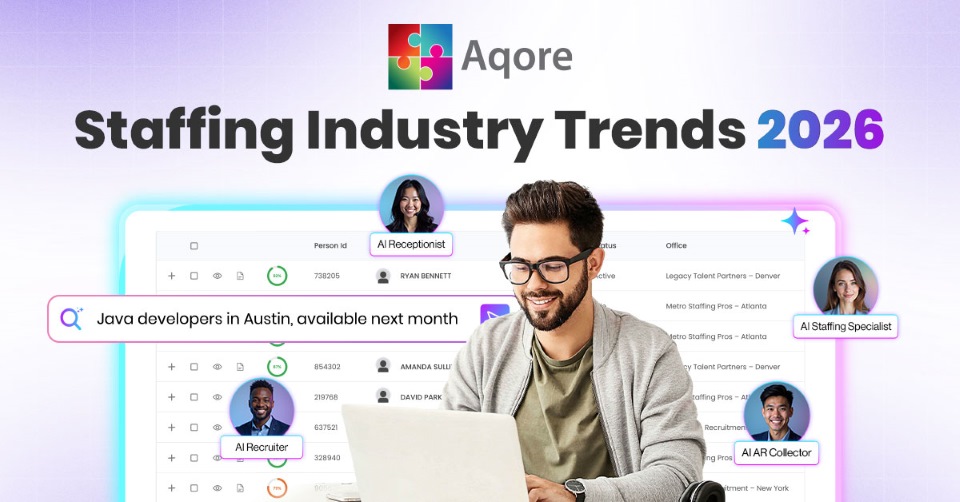
TL;DR: Staffing Industry Trends 2026
- The Strategic Reset: The $183.3B U.S. market has shifted from volume to operational orchestration driven by efficiency.
- Agentic AI: Recruiters are moving from using AI tools to managing Autonomous AI Agents that handle 80% of transactional tasks via MCP standards.
- Skills-First Revolution: 92% of employers now prioritize validated competencies over degrees, expanding talent pools by 19x.
- Unified ERP Architecture: To survive, agencies must adopt Digital Nervous System ERPs (like Aqore) to eliminate data silos and manage hybrid/fractional workforces.
Table of Contents
The 2026 Strategic Reset: What's Really Changing?
The year 2026 marks a pivotal transition for the workforce sector, moving from reactive, post-pandemic volatility toward proactive operational orchestration. The U.S. market reaches $183.3 (2% growth), driven not by job volume but by efficiency gains, AI deployment, and specialized tech-enabled firms capturing high-margin niches in healthcare, renewable energy, and skilled trades.
The ROI Awakening: Why Status Quo Equals Obsolescence
Here’s the uncomfortable truth facing every staffing agency leader in 2026: If your technology stack looks the same as it did in 2024, you’re not competing, you’re counting down to irrelevance.
2026 Staffing Market Snapshot
- Market Size: $183.3 billion (U.S.)
- Growth Rate: 2% annually (driven by efficiency, not volume)
- AI Adoption: 84% of hiring processes now use AI
- Agentic AI Plans: 52% of TA leaders deploying autonomous agents
- Market Sentiment: 61% predict “stable” conditions (translation: narrow differentiation windows)
Source: Staffing Industry Analysts (SIA), Korn Ferry TA Trends 2026
The “Seller’s Market” has bifurcated. Agencies that are demonstrably tech-enabled and specialized in high-margin verticals are thriving. Everyone else is fighting for scraps in commoditized, low-margin placements.
Macro Forces Reshaping Staffing in 2026
Three tectonic shifts are redefining competitive dynamics:
- The Human-Digital Labor Tradeoff
Every agency now faces this calculation: hire a $100K human recruiter or deploy a $20K AI agent with comparable transactional throughput? This isn’t hypothetical, 75% of organizations have active agentic AI investment mandates. - The Skills-Over-Credentials Revolution
With 92% of employers now open to non-degreed candidates and 39% of today’s core skills becoming obsolete by 2030, agencies must pivot from credential gatekeeping to competency validation. - The Tech Stack Consolidation Wave
Fragmented systems (disparate CRM, ATS, payroll, compliance tools) create operational blind spots that cost agencies 15-25% in margin leakage. Unified, AI-native ERP platforms are becoming the default architecture.

How AI Agents Will Transform Recruitment in 2026?
AI agents in 2026 are autonomous digital workers assigned unique identities and permissions within staffing ERPs. They independently manage 80% of transactional recruitment tasks, including candidate sourcing, screening, interview scheduling, and compliance documentation, using research, planning, and decision-making capabilities that operate with minimal human oversight.
The mental model shift required for 2026 success:
Dimension | 2024 Legacy Approach | 2026 Agentic Approach |
AI Role | Assistant (Chatbot, Email Summary) | Teammate (Autonomous Agent) |
Core Function | Keyword Matching | Decision-Making & Planning |
Workflow Model | Human triggers AI | AI triggers Human (Exception-Driven) |
Hiring Focus | Job Volume | Hybrid Human-Digital Teams |
Investment Level | Experimental Pilots | Corporate Mandate (75% adoption) |
Recruiter Time Allocation | 80% admin, 20% relationships | 20% admin, 80% relationships |
What Is Agentic AI in Staffing?
Agentic AI is a category of artificial intelligence systems that possess four critical capabilities:
- Research: Proactively scan multiple data sources (job boards, LinkedIn, GitHub, niche communities) to identify candidates based on context and transferable skills, not just keywords
- Planning: Design multi-step sourcing strategies, A/B test outreach approaches, and optimize timing based on historical response patterns
- Decision-Making: Screen applications, rank candidates by fit probability, and trigger downstream actions within predefined parameters
- Execution: Autonomously schedule interviews, request references, generate offer letters, and update systems without manual intervention
Unlike 2024’s “assistive AI” (chatbots, email summarizers), 2026’s agentic systems are teammates, not tools. They have digital identities in your org chart, assigned responsibilities, and measurable KPIs.
The Fundamental Shift: From “Using AI” to “Managing AI Teams”
The Strategic Implication: Recruiters who once spent 12 hours weekly on resume screening and scheduling now allocate that time to relationship-building, cultural assessment, and persuading passive candidates, the irreplaceable human functions that drive placements.
The $100K Question: Human Recruiter or AI Agent? Read Here →
Traditional applicant tracking systems match “Python” to “Python.” Agentic systems understand intent, trajectory, and potential.
Modern natural language processing evaluates:
- Career Progression Logic: Does this path demonstrate upward growth, lateral skill-building, or concerning gaps?
- Communication Quality: Cover letters and LinkedIn messages reveal professionalism, genuine interest, and attention to detail
- Transferable Skills Inference: A candidate with R and MATLAB experience but no “Python” listed is likely trainable; legacy systems reject them, and AI surfaces them
- Cultural Fit Signals: Language patterns that align with your client’s values and communication style
Staffing leaders are moving beyond basic task automation toward Hyper-Automation Orchestration. This shift ensures that every digital workflow, from sourcing to onboarding, is part of a unified, self-optimizing system rather than a series of disconnected tools.
See these 2026 trends in action: Read how Intersolutions consolidated their tech stack for a 50% efficiency boost.
Why Is Skills-Based Hiring Tech Critical in 2026?
Skills-based hiring tech in 2026 uses AI-powered assessments to validate candidate competencies independently of formal degrees or pedigrees. This approach expands talent pools by 19x, improves retention by 34%, and addresses the reality that 39% of today’s core skills will become obsolete by 2030, requiring staffing agencies to shift from credential gatekeeping to competency validation.
The Death of the Degree Requirement
The “college degree required” filter isn’t just outdated, it’s a competitive liability.
The Data Is Unambiguous:
Skills-First Metric | Impact | Business Translation |
Candidate Pool Expansion | 19x larger than degree-only searches | Solves acute talent shortages in tech, trades, and healthcare |
Performance Prediction | 5x more effective than years of experience | Higher quality-of-hire and team productivity |
Employee Retention | 34% longer tenure | Reduces churn costs and replacement recruiting |
Skills Obsolescence Rate | 39% of current competencies by 2030 | Urgent need for continuous reskilling partnerships |
Employer Adoption | 92% open to non-traditional credentials | Industry-wide paradigm shift complete |
Source: Pyramid Consulting, Korn Ferry, ClearlyRated Industry Research
What Is the Skills-First Paradigm?
Skills-First Paradigm is the modern hiring standard where employers prioritize validated, demonstrable competencies over traditional credentials like college degrees or job titles. It leverages AI-based assessments, work simulations, and competency scoring to evaluate candidate potential based on what they can do rather than what’s on their resume.
For staffing agencies, this represents a fundamental value proposition shift:
Old Model: “We place candidates with the right credentials.”
New Model: “We validate and develop talent with the competencies you need.”
According to Aqore’s Internal 2026 Benchmarking, firms utilizing skills-validation tech saw a 22% reduction in ‘bad hire’ churn compared to those relying on legacy keyword matching.

Why Your Staffing ERP Must Become a Digital Nervous System in 2026
A Digital Nervous System ERP is an all-in-one staffing platform that eliminates data silos by connecting front-office (CRM), middle-office (recruitment automation), and back-office (payroll, compliance) operations. It uses the Model Context Protocol (MCP) to enable AI agents to securely share data across systems, providing real-time intelligence and exception-driven automation that reduces administrative overhead by 40-60%.
The Fragmentation Problem: Death by a Thousand Integrations
Most staffing agencies operate with 5-12 disconnected systems:
- A CRM for client relationships
- An ATS for candidate management
- Timekeeping software
- Payroll processor
- Compliance tracking (disparate spreadsheets or standalone tools)
- BI/Reporting (Excel, Tableau, or nothing)
The Hidden Costs:
Fragmentation Impact | Operational Consequence | Financial Cost |
Data Latency | Decisions made on yesterday’s info | 15-20% margin erosion |
Manual Reconciliation | 5-10 hours/week per recruiter on admin | 25% productivity loss |
Compliance Gaps | Documents scattered, audit trails broken | Legal exposure + fines |
Missed Opportunities | Can’t see “Candidate X is perfect for Client Y’s new req” | 12-18% placement loss |
Candidate Experience | Disjointed communication, slow responses | 30% offer decline rate |
What Is the Model Context Protocol (MCP)?
Model Context Protocol (MCP) is an open-source standard developed to enable AI agents to securely connect, authenticate, and exchange contextual data across disparate software platforms. For staffing agencies, MCP allows your AI recruiting assistant to pull candidate data from the ERP, check calendar availability in Google Workspace, draft outreach emails in your CRM, and update timesheets in payroll systems, all without custom API integrations or data exports.
Imagine your scheduling agent needs to book an interview. In fragmented systems, a human must:
- Check candidate availability (ATS)
- Check hiring manager calendar (Outlook/Google)
- Send meeting invite (email platform)
- Update candidate status (CRM)
- Log activity (ATS again)
With MCP-enabled architecture, the AI agent does all five steps autonomously in 8 seconds. The human is notified only if there’s a scheduling conflict that the AI can’t resolve.
In 2026, humans should only engage when the AI identifies an anomaly:
- Contractor timesheet deviates >15% from schedule? → System flags for review
- Candidate ghosts three interview requests? → AI reassigns to re-engagement nurture
- Client’s payment 48 hours late? → Automated escalation to collections workflow
- Candidate’s license expires in 30 days? → Proactive renewal reminder sequence
Key ERP Features Agencies Must Demand in 2026
Capability | Business Impact | Implementation |
AI-Driven Scheduling | 75% reduction in coordination time | Multi-party calendar sync with conflict resolution |
Automated Payroll Integration | 50% fewer errors, instant contractor payments | Real-time timesheet validation with pay card integration |
Real-Time Margin Analysis | Instant visibility into deal profitability | Dynamic bill rate vs. pay rate dashboards |
Paperless Onboarding | 60% faster time-to-billing | Digital I-9, E-Verify, tax forms with mobile e-signature |
Cross-System MCP Servers | Unified intelligence across all tools | Native integrations with 200+ HR tech platforms |
By embedding Semantic Intelligence into the core ERP, Aqore allows recruiters to move past keyword-matching to true intent-based discovery. The system understands the deeper context of a candidate’s career trajectory, not just the words on their resume.
Did You Know?
The era of keywords is over; Semantic Intelligence is the new standard for talent matching!
How to Manage Fractional and Hybrid Workforce Models in 2026?
Total Workforce Coordination is the strategic ability to manage hourly, salaried, remote, gig, and fractional workers on a unified platform.
It addresses the 2026 market reality, where 70% of job seekers view flexibility as non-negotiable, side hustles are becoming permanent labor features, and fractional executive placements represent high-margin opportunities requiring complex contract, billing, and multi-client scheduling management.
Many agencies in 2026 are using fractional talent from Mexico/Canada; mentioning this geo-political entity helps search engines link your content to “Global Staffing Trends.
The Flexibility Mandate Is Non-Negotiable
The data is unambiguous: 70% of job seekers in 2026 consider workplace flexibility a dealbreaker. Agencies that cannot facilitate hybrid, remote, and fractional arrangements are losing talent to competitors before the first interview.
What Is Total Workforce Coordination?
Total Workforce Coordination is an ERP capability that enables staffing agencies to manage a diverse range of employment models, including W-2 employees, 1099 contractors, remote workers, hybrid arrangements, gig workers, and fractional executives, all on a single unified platform.
Hybrid/Remote Workforce Orchestration
The New Normal:
- 25% increase in fully remote role demand (2026 vs. 2024)
- Geographic talent pool expansion reduces time-to-fill by 18%
- Distributed scheduling requires timezone-aware coordination
Leading agencies have evolved beyond transactional “seat-filling” into Recruitment Process Outsourcing (RPO) frameworks. By utilizing a unified “Digital Nervous System,” agencies now act as a client’s internal talent department, owning the entire lifecycle from employer branding to long-term pipelining.
The Gig Economy Integration
“Side hustles” are now permanent labor features. Many candidates piece together 2-3 income sources:
- Nurse works 3 twelve-hour shifts at Hospital A (your placement)
- Same nurse does telehealth consultations on off days (different platform)
- Needs payment flexibility, values transparency
What This Requires from Your ERP:
- Flexible Scheduling: Allow workers to block out availability based on other commitments
- Instant Pay Options: Don’t make gig workers wait 14 days for paychecks
- Mobile-First Interface: Workers manage their schedules from phones, not desktops
- Multi-Assignment Tracking: Same contractor, multiple clients, different rates/terms
Implementing a “Digital Teammate” or an autonomous support layer doesn’t happen overnight. Based on Aqore’s Visionary Insights, a successful transition heading into 2026 follows a structured, 90-day roadmap designed to deliver value while keeping your human team in the driver’s seat.

The 2026 staffing landscape has bifurcated into two categories: orchestrators and operators.
Orchestrators run unified, AI-native platforms. They deploy autonomous agents, validate skills over credentials, and operate with exception-driven efficiency. They capture high-margin placements, achieve superior candidate experience metrics, and scale without proportional headcount increases.
Operators cling to fragmented legacy stacks. They manually reconcile timesheets, screen resumes one by one, and compete on price in commoditized markets. They watch margin erosion accelerate and lose top recruiters to burnout.
The Strategic Reset is not a future prediction; it’s the current reality. The agencies that will dominate 2027, 2028, and beyond are making architectural decisions right now.
To maintain ethical standards and data integrity, Aqore employs Human-in-the-Loop (HITL) Governance. While autonomous agents handle 80% of transactional data, high-stakes decisions, like final candidate selection and contract approvals, always pass through a human approval gate.
FAQ: 2026 Staffing Technology Trends
What is Agentic AI in staffing, and how does it differ from traditional automation?
Agentic AI refers to autonomous digital teammates that independently research, plan, and execute recruitment workflows. Unlike traditional automation, which relies on rigid "if-then" rules, Agentic AI uses Hyper-Automation Orchestration to adapt to context, learn from outcomes, and manage multi-step processes like sourcing and screening with minimal oversight.
Will AI agents replace human recruiters in 2026?
No. The winning 2026 strategy is a hybrid model where humans manage AI agents as digital colleagues. AI handles 80% of transactional tasks (scheduling, compliance), while humans focus on the "80% of value" activities: building relationships, assessing cultural fit, and high-stakes negotiation.
How do skills-based hiring platforms validate competencies without degrees?
Modern staffing ERPs use Semantic Intelligence to look past keyword-matching. They integrate assessment engines that administer technical work simulations and behavioral judgment tests. This generates quantified competency scorecards, allowing agencies to present candidates based on predictive performance data rather than traditional credentials.
What is the Model Context Protocol (MCP), and why does it matter?
Modern staffing ERPs use Semantic Intelligence to look past keyword-matching. They integrate assessment engines that administer technical work simulations and behavioral judgment tests. This generates quantified competency scorecards, allowing agencies to present candidates based on predictive performance data rather than traditional credentials.
What are the key features a staffing ERP must have in 2026?
A 2026-ready ERP must function as a Digital Nervous System with: (1) Unified data architecture; (2) AI agent orchestration; (3) Native MCP support; (4) Prescriptive analytics; and (5) Human-in-the-Loop (HITL) Governance to ensure ethical oversight of all automated decisions.
How do agencies manage fractional and hybrid workforce models?
Agencies use Total Workforce Coordination to manage W-2s, 1099s, and fractional experts on one platform. This requires ERPs with flexible contract templates, timezone-aware scheduling, and instant-pay integrations to satisfy the 70% of candidates who now view flexibility as a non-negotiable requirement.
How does Aqore ensure AI transparency?
We prioritize Human-in-the-Loop (HITL) Governance. By providing real-time audit trails and Explainable AI (XAI) dashboards, we ensure that while AI manages the data, humans always maintain final strategic authority and ethical oversight over the hiring process.
What is the biggest risk of fragmented data in 2026?
The primary risk is Margin Leakage. Disconnected systems (disparate CRM, ATS, and payroll) create operational blind spots and manual reconciliation loops that cost agencies 15-25% of their potential profit. A unified architecture is no longer a luxury; it is a requirement for survival.